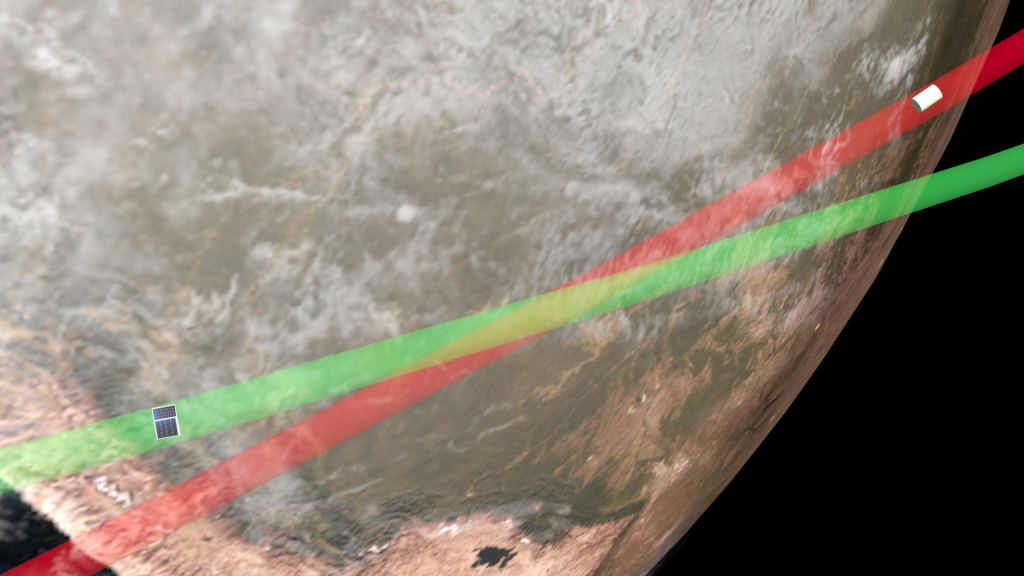
Following completion of the SpaceWERX Orbital Prime Phase I program, Orbital Bridge submitted three proposals for continued development: a Phase II STTR proposal for CoVAISAMO, a Direct-to-Phase II SBIR proposal for Orbital SLAM, and a Direct-to-Phase II proposal for the Borg Cube satellite bus.
CoVAISAMO Phase II proposed completing the ROS 2-compatible computer-vision libraries begun during Phase I and integrating Orbital SLAM into the system. Together, the technologies would provide autonomous spacecraft with visual odometry, navigation, situational awareness, conjunction forecasting, and dynamically updated three-dimensional digital twins of orbital environments.
Orbital SLAM proposed a new Simultaneous Localization and Mapping system designed specifically for space. Conventional robotics SLAM assumes gravity, relatively small operating areas, and movement across a largely flat plane. Orbital SLAM was designed to support multiple frames of reference, true three-dimensional movement, orbital-scale distances, and objects traveling at relative velocities approaching 30 kilometers per second. The software would run on commercial edge computers, reducing or eliminating the need for round-trip communications when planning autonomous maneuvers.
The Borg Cube proposal described a robust, highly maneuverable, general-purpose, in-space refuellable satellite bus. Eight tri-corner thruster assemblies would provide twenty-four independently controlled flow actuators. Rather than manually programming every possible combination, a convolutional neural network would be trained in a physically realistic simulation to teach the spacecraft how to maneuver and achieve commanded objectives.
Both CoVAISAMO Phase II and Orbital SLAM were evaluated as Selectable, Not Funded. This designation meant that the proposals met the government’s standard for possible selection, but no contract award or funding was provided.
Orbital Bridge ultimately elected not to continue pursuing the unfunded projects. The STTR structure required academic partnership arrangements and administrative overhead that the company did not wish to carry forward. Orbital SLAM was also moving Orbital Bridge increasingly toward specialized spacecraft software and away from its original mission: Humanity in Space, at Scale.
The decision was strategic rather than technical. The proposals demonstrated that Orbital Bridge could develop credible technologies across artificial intelligence, autonomous spacecraft operations, satellite design, and orbital logistics, but the company chose to concentrate its resources on the larger launch and infrastructure problem it was founded to solve.
One technical correction I made deliberately: SLAM normally means Simultaneous Localization and Mapping, not “Location and Mapping,” and CNN means convolutional neural network, not “convoluted neural network.”