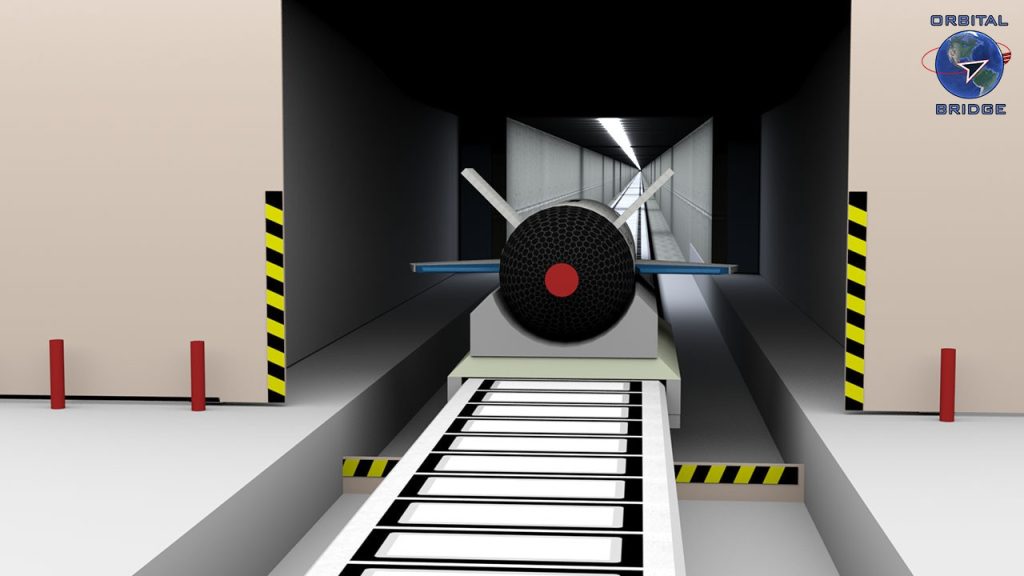
Introduction: Orbital Bridge Launch is a patent-pending, innovative launch system that redefines the current space launch paradigm. It eliminates the need for the traditional Stage One of a liquid-fueled rocket through a process we call re-entry in reverse. The patent, US 11,987,391, is titled “Systems and Methods for Horizontal Sea Level Launching of Space Vehicles Using Magnetic Levitation, Linear Acceleration, Thermal Energy Scavenging, and a Steam Rocket Engine.”
(edit: The patent was subsequently granted as U.S. Patent No. 11,987,391 on May 21, 2024.)
System Overview: The Orbital Bridge Launch system is a Space Plane Launch Vehicle (SPLV) that undergoes a unique launch process:
Acceleration: The SPLV is accelerated at 15 G for nearly 30 seconds on magnetically levitated hypersonic sled traveling down a 30 km perfectly straight maglev rail.Power Source: The system uses 400 MW of power, applied over the 30-second acceleration period, for 12 Gigajoules of Stage One power.Steam Rocket Engine: The SPLV uses 600°C supercritical steam, which at the proposed operating conditions, contains several megajoules of thermal energy per liter. This supercritical steam is much more energetic than ordinary 100°C steam.
Key Features:
- Magnetic Levitation and Linear Acceleration: The SPLV rides on a hypersonic sled, accelerated using magnetic levitation and electromagnetic linear acceleration.
- Evacuated Tunnel: Most of the 30 km journey occurs in an evacuated tunnel with only 5% of atmospheric pressure, significantly reducing hypersonic shockwaves and drag.
- Thermal Energy Scavenging: The supercritical steam is used as a coolant, absorbing heat generated during the launch process, enhancing the fuel’s energy density, and substantially increasing thrust.
Launch Process:
- Initial Acceleration: The SPLV is rapidly accelerated in the evacuated tunnel.
- Pressure Equalization: Near the end of the evacuated tunnel, the SPLV transitions rapidly into progressively denser atmospheric conditions, subjecting the vehicle to extreme aerodynamic pressure and heating for approximately ten seconds.
- Max-Q: The maximum dynamic pressure (Max-Q) reaches just over 9 MPa.
- Temperature: Post-shockwave temperatures exceed 5000°C.
- Cooling System: Leveraging the Zeroth Law of Thermodynamics, the supercritical steam removes heat from the SPLV’s surfaces and discharges it through the exhaust. The modeled system is intended to transfer as much as 250 MW of thermal energy from the vehicle surfaces into the working fluid, reducing the risk of catastrophic thermal failure.
Advantages:
- Energy Absorption: Supercritical steam can absorb large amounts of energy, with its pressure rising along with temperature, making it ideal for rocket propulsion.
- Theoretical ISP: The system aims to discharge high-temperature supercritical steam, potentially achieving a high specific impulse (ISP).
Challenges and Potential:
- Material Science: Handling the extreme conditions of 900°C – 1200°C supercritical steam requires advanced materials, which are currently at the forefront of material science.
- Development and Testing: The next step involves raising capital to build and test prototypes. While theoretical models are promising, real-world testing will determine the system’s feasibility and performance.
Complementing Existing Systems:
- Durable Cargo: Orbital Bridge Launch is designed for durable goods only, such as plating, shielding, tubing, batteries, fuel, water, foodstuffs, and so much more.
- Collaboration with Space X and Blue Origin: While SpaceX and Blue Origin will continue to handle human missions and delicate cargo, Orbital Bridge will focus on providing a steady stream of materials to support space construction and other ventures.
Environmental Impact: The environmental impact of traditional space launches, especially those using methane/liquid oxygen (LOX) rockets, includes the emission of greenhouse gases and other pollutants. These launches release significant amounts of CO2 into the upper atmosphere, potentially affecting atmospheric chemistry and contributing to climate change. Additionally, the combustion of rocket fuels can produce particulate matter and other harmful substances as artifacts.
In contrast, the Orbital Bridge Launch system is designed with sustainability in mind:
- Electricity and Water Inputs: The system uses only electricity and water as inputs, significantly reducing the environmental footprint compared to traditional rocket launches.
- Zero Combustion Artifacts: The SPLV’s exhaust consists solely of pure water vapor, with no combustion by-products. This eliminates the release of greenhouse gases and pollutants associated with traditional rocket launches.
- Renewable Energy Potential: The electricity used for the launch system can be sourced from renewable energy, further minimizing the environmental impact.
By using a clean and efficient launch method, Orbital Bridge Launch not only aims to revolutionize space access but also to set a new standard for environmentally responsible space exploration.
Conclusion: Orbital Bridge Launch is an enablement technology that aims to revolutionize space logistics by providing a cost-effective, high-frequency launch solution for durable cargo. By doing so, it will support the broader goals of human expansion into space, making space habitats and construction projects more feasible and sustainable.